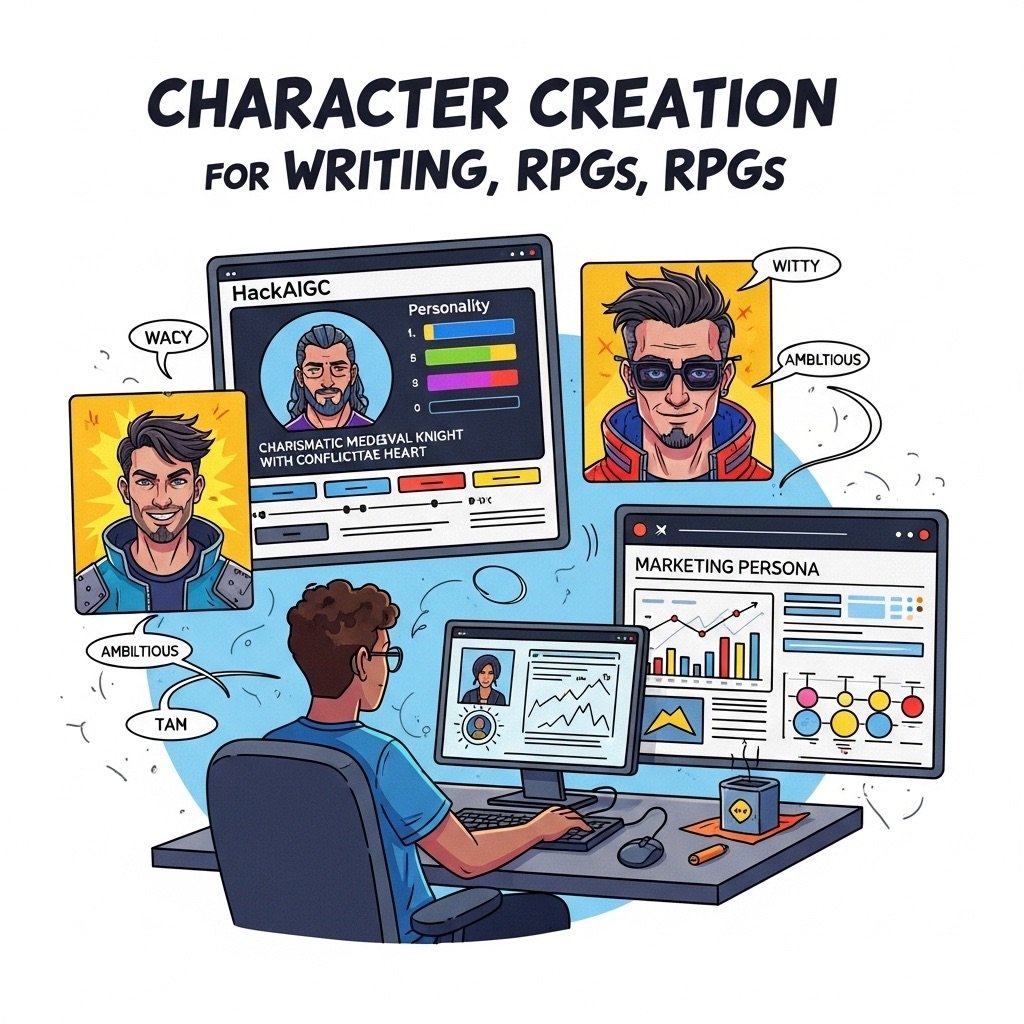
Every writer knows the thrill of a compelling story, but that thrill often comes hand-in-hand with the challenge of populating it with memorable characters. Sometimes, the creative well runs dry, leaving you struggling to give even a minor character a distinct flair. This is where Personality & Emotional Trait Generators become your secret weapon, transforming the daunting task of character development into an inspiring playground of possibilities.
Whether you're sketching a fleeting barista, a formidable antagonist, or a loyal sidekick, these digital tools offer a rich tapestry of attributes to make each individual in your narrative truly unique. They help you sidestep common pitfalls like repetitive characterizations and writer's block, ensuring your story world feels vibrant and alive with diverse personalities.
At a Glance: Harnessing Trait Generators
- Problem Solved: Overcome writer's block, avoid character repetition, and add depth to even minor roles.
- What They Do: Generate a wide range of positive, negative, and neutral personality traits.
- Beyond Randomness: Use them to spark ideas, develop conflicting traits, or explore societal views impacting a character.
- Best For: Side characters, tabletop RPGs, world-building prompts, or jumpstarting main character concepts.
- Key Tip: Don't just copy-paste; use generated traits as a foundation for deeper exploration and story integration.
The Character Creator's Conundrum: When Originality Feels Elusive
Imagine you're building a bustling fantasy city, a gritty space station, or a quaint suburban town. Each setting demands a cast of characters—hundreds, perhaps, if you count background figures, shopkeepers, guards, and fleeting acquaintances. Giving all of them distinct personality and emotional traits without resorting to the same handful of archetypes can feel like an insurmountable task. You might find yourself recycling "grumpy but kind" or "shy and observant" until your narrative starts to feel a bit... flat.
This struggle is precisely what fantasynamegenerators.com highlights: "When (side) characters become more and more numerous in a story, it can be difficult to give them character traits without resulting to using the sames ones over and over and without breaking the creative flow." The creative flow is a delicate thing, easily disrupted by the mental gymnastics required to conjure fresh personality details on demand. This is where trait generators step in, offering a much-needed jolt of inspiration.
What Exactly Are Personality & Emotional Trait Generators?
At their core, these generators are digital tools that randomize a vast database of descriptive words and phrases related to human behavior, emotions, and temperament. They can range from simple lists of adjectives to more nuanced descriptions that offer a glimpse into a character's inner world.
Think of them as a brainstorming partner that never tires. With a single click, you can receive a fresh batch of traits. Some, like the one found on perchance.org, aim to give you a balanced mix: "4 positive traits, 3 neutral traits, and 2 negative traits." This approach acknowledges the complexity of real people, who rarely fit neatly into a single category. For example, you might get a combination like "humorous, peaceful, freethinking, and clean; dreamy, ordinary, and guileless; meddlesome and unreliable."
The beauty of such a varied output lies in its ability to present traits that might even conflict. A character who is both "peaceful" and "meddlesome" immediately creates an intriguing tension, begging the question: How do these contradictory elements coexist? That's the stuff compelling stories are made of.
Beyond the Surface: The Power of Generated Traits
While the immediate benefit is obvious—you get a list of traits—the true power of these generators lies in their ability to ignite your imagination in several key ways:
Sparking Unexpected Combinations
Sometimes, a generator will pair two traits you never would have considered. "Optimistic but cynical," "fiercely loyal yet deeply suspicious," or "meticulous but utterly disorganized." These juxtapositions are gold mines for character development, forcing you to think about the internal struggles and external behaviors that define such a person. They provide a unique lens through which to view your character, pushing them beyond predictable tropes.
Breaking Creative Blocks
When you're staring at a blank page or struggling to differentiate two similar characters, a generator can provide the spark. Instead of forcing an idea, you can let the tool offer a starting point. This often frees up your mental energy, allowing you to focus on how these traits will influence the story, rather than what they should be.
Injecting Realism and Nuance
As noted by fantasynamegenerators.com, some traits "can be either depending on the circumstances or interpretation" or "can be negative or positive purely based on a (skewed) societal view." This crucial insight encourages you to think beyond simple good/bad labels. A trait like "ambitious" might be positive in a meritocracy but negative in a communal society. "Reserved" might be seen as sophisticated by some, but cold by others. Generators, by offering a broad spectrum, implicitly remind us of this inherent subjectivity.
Unpacking the Trait Spectrum: Positive, Negative, and Nuanced
When you Generate character traits, you'll often encounter a mix that mirrors the complexity of real human beings. Understanding these categories—and their fluidity—is key to using them effectively.
Positive Traits: Strengths and Virtues
These are the attributes that typically evoke admiration or respect. Think "courageous," "empathetic," "diligent," "optimistic," "loyal," or "generous." They form the foundation of a character's admirable qualities and often drive their heroic or selfless actions.
Negative Traits: Flaws and Vices
These are the attributes that present challenges, create conflict, or define a character's darker side. Examples include "selfish," "cowardly," "impulsive," "deceitful," "arrogant," or "vindictive." A character's flaws are just as vital as their strengths, often making them more relatable and providing opportunities for growth or downfall. Remember, a character without flaws is often a boring one.
Neutral Traits: Contextual Qualities
Many traits fall into a neutral category, meaning their impact is entirely dependent on context, interpretation, or the specific situation. "Quiet," "reserved," "dreamy," "meticulous," "guileless," or "ordinary" are good examples. A "quiet" character might be perceived as thoughtful by some, but aloof by others. "Meticulous" can be a strength for a surgeon but a frustrating flaw for a spontaneous adventurer. These traits add subtle layers and can shift in meaning throughout a narrative, reflecting dynamic character development.
Conflicting Traits: The Engine of Internal Struggle
The perchance.org generator explicitly notes that generated traits "may conflict with each other." Embrace this! A character who is "fiercely independent" but also "craves validation" is immediately more compelling than one who is simply "independent." These internal contradictions create rich opportunities for character arcs, dilemmas, and unexpected decisions. They mimic the genuine paradoxes we observe in real people, making your fictional beings feel more authentic.
Crafting Your Character Arc: Using Traits for Development
Traits aren't static labels; they're dynamic components that can drive a character's journey. Here’s how to use generated traits to build a compelling arc:
The Starting Point: Initial Personality
Use the initial batch of generated traits to define your character at the beginning of your story. This establishes their baseline, showing the reader who they are before events begin to reshape them. For instance, a character generated as "naive, trusting, and adventurous" sets a clear initial profile.
Introducing Conflict: The Crucible of Change
As the story progresses, challenge your character's dominant traits. What happens when a "naive" character is betrayed? How does a "trusting" individual react to deceit? This conflict forces them to confront their existing personality, potentially leading to change. A trait that was once positive might become a liability, or a negative trait might be inadvertently beneficial.
Growth and Transformation: Evolving Traits
Character development isn't about changing every trait, but rather showing how certain traits are reinforced, challenged, or evolve. Perhaps the "naive" character, after betrayal, develops a new trait of "cautious" or even "suspicious." The "adventurous" trait might transform from reckless curiosity to calculated bravery. Use traits as markers of growth, showing how experiences forge new aspects of their personality.
Best Practices for Integrating Generated Traits
Simply copying a list of traits won't automatically create a deep character. Here's how to use generators like a pro:
- Don't Just Copy-Paste; Interpret and Expand: A trait like "dreamy" is a good start, but what do they dream about? How does it manifest? Do they gaze out windows, doodle in notebooks, or get lost in thought during conversations? Connect the trait to specific behaviors and internal monologues.
- Mix and Match for Originality: If one generator gives you "loyal" and another gives "witty," combine them. The best characters are often a mosaic of traits from different sources, even conflicting ones. Don't feel beholden to one generator's output.
- Context is Key: How Do Traits Serve Your Story? Every trait should ideally have a purpose. Does "meddlesome" drive the plot forward by having the character interfere? Does "unreliable" create tension or humorous situations? If a trait doesn't contribute, consider tweaking or discarding it.
- Layering for Depth: Start with 2-3 core traits. Then, add secondary traits that complement or subtly contradict them. A "brave" knight who is also "secretly superstitious" is far more interesting than just a "brave" knight.
- The "Why" Behind the "What": Once you have a trait, ask yourself why your character possesses it. Was it upbringing? A traumatic event? A conscious choice? Understanding the origin of a trait adds immense depth and allows for more consistent character portrayal.
When to Reach for a Generator (and When Not To)
These tools are incredibly helpful, but they're not a one-size-fits-all solution.
When They Shine:
- Side Characters: For the myriad of supporting roles in your story, generators are invaluable time-savers that ensure variety.
- Tabletop RPGs (TTRPGs): Creating an entire adventuring party or a host of NPCs on the fly becomes much easier.
- World-Building Prompts: Need to flesh out the typical personality of a certain race, profession, or cultural group in your fictional world? Generators can offer a starting point.
- Breaking Writer's Block: When you're stuck, a random trait can be the spark that ignites a new idea for a character or even an entire plot point.
- Experimentation: Trying out different personality combinations can lead to surprising insights, even for your main characters.
When to Rely on Deeper Development:
- Primary Protagonists and Antagonists: While generators can start the process, your main characters deserve a deeper, more deliberate approach. You'll want to carefully select traits that directly serve their arc and the central themes of your story, rather than leaving it purely to chance.
- Characters with Specific Thematic Roles: If a character needs to embody a very specific idea or archetype to serve your story's message, a random generator might give you conflicting signals. In these cases, it's better to curate their traits intentionally.
Common Pitfalls to Avoid
Even with the best tools, it's possible to misuse them. Keep these watch-outs in mind:
- Stereotyping: Don't let a generated trait lead you down the path of a one-dimensional stereotype. "Grumpy" shouldn't automatically mean they hate everyone; explore the nuances. Perhaps they're grumpy because they're deeply insecure.
- Inconsistent Application: If your character is "observant," ensure their actions and internal thoughts consistently reflect this trait throughout the story. Don't have them miss obvious clues simply because it's convenient for the plot.
- Over-Reliance: Generators are aids, not replacements for your creative input. Use them to inspire, not dictate. Always filter the output through your own vision for the character and story.
- Ignoring Conflict: As mentioned, conflicting traits are powerful. Don't smooth them out; lean into them to create internal and external struggle.
Beyond Fiction: Other Applications
The utility of Personality & Emotional Trait Generators extends beyond novel writing:
- Role-Playing Games (RPGs): Whether you're a Game Master needing quick NPC ideas or a player developing a new character, these tools are invaluable.
- Improvisational Acting: Need a quick character sketch for a scene? A few generated traits can provide a solid foundation.
- Self-Reflection (with Caution): While not their primary purpose, seeing a list of random traits might occasionally spark insights into your own personality or the people around you, prompting reflection on how different traits manifest.
Your Next Step to Deeper Characters
Creating truly memorable characters is an art, and like any art, it benefits from both inspiration and deliberate practice. Personality & Emotional Trait Generators offer a powerful, accessible way to inject that vital spark of originality and depth into your fictional creations. They challenge you to think beyond the obvious, embrace contradiction, and discover the subtle nuances that make characters leap off the page and into the reader's heart.
So, the next time you find yourself stuck, staring at a blank character sheet, remember that a world of unique personalities is just a click away. Use these tools as a launchpad, let their suggestions broaden your horizons, and then dive deep, shaping those raw ideas into the compelling individuals your stories deserve. The key is to engage with the generated traits, question them, and weave them into the rich tapestry of your narrative, allowing your characters to surprise both you and your readers.